
Oct
You signed a joint tax return because you trusted your spouse. Now the IRS says you owe thousands of dollars in tax you never knew about, and it wants you to pay. That feels deeply unfair, and the law agrees it can be.
When you file a joint tax return, both spouses are usually responsible for the full balance, even after a divorce. Innocent spouse relief is the IRS’s way of fixing that when one spouse caused the problem and the other didn’t. This Innocent Spouse Relief Blog walks you through the four types of relief, who qualifies, how to request it on Form 8857, and when to bring in a tax attorney so you don’t lose your best option to a missed deadline.
Table of Contents
- What Innocent Spouse Relief Is (and What It Isn’t)
- The Four Types of Innocent Spouse Relief
- How to Qualify for Innocent Spouse Relief
- How to Request Innocent Spouse Relief With Form 8857
- Mistakes That Sink a Relief Case
- When to Bring In a Tax Attorney
- Innocent Spouse Relief FAQs
- Key Takeaways
What Innocent Spouse Relief Is (and What It Isn’t)
Under tax law, a joint return creates “joint and several” liability. In plain terms, the IRS can collect the entire tax debt from either spouse, no matter who earned the money or made the mistake. Innocent spouse relief lets a requesting spouse ask the IRS to remove some or all of that tax, interest, and penalties.
It’s easy to confuse this with injured spouse relief, but they solve different problems.
| Innocent Spouse Relief | Injured Spouse Relief | |
|---|---|---|
| The problem | You’re being held liable for tax your spouse caused | Your share of a joint refund was taken to pay your spouse’s separate debt |
| Common cause | Unreported income or a false deduction on a joint return | Your spouse’s past-due child support, student loans, or old taxes |
| IRS form | Form 8857 | Form 8379 |
| Result | Relief from a tax liability | Your portion of the refund is returned |
Practical takeaway: If the IRS took your refund for your spouse’s old debt, you’re likely an injured spouse. If the IRS is billing you for tax your spouse owes, keep reading.
The Four Types of Innocent Spouse Relief
The IRS recognizes four distinct forms of relief. You don’t have to pick one. When you file Form 8857, the IRS reviews your facts and circumstances under every type that might apply. For a deeper breakdown of each option, see our innocent spouse relief services page.
1. Classic Innocent Spouse Relief
This applies when your spouse failed to report income or claimed an improper deduction or credit, creating an understated tax. You must show you didn’t know, and had no reason to know, about the error when you signed. Example: Your husband ran a side business and never reported $40,000 in cash income. You never saw the money or the records.
2. Separation of Liability Relief
This splits the additional tax between you and your spouse or former spouse, as if you had filed separately. You must be divorced, legally separated, widowed, or not living in the same household for the 12 months before you file. Example: After a divorce, you’re assigned only the tax tied to your own W-2 wages, not your ex’s unreported crypto gains.
3. Equitable Relief
This is the broadest option. It covers both understated tax and unpaid tax that was properly reported but never paid. The IRS grants it when it would be unfair to hold you liable. Example: Your spouse told you the tax due was paid, then spent the money instead.
4. Relief From Community Property Laws
In community property states like California, income is often split 50/50 by law, even on separate returns. This relief may help if you didn’t file jointly but are being taxed on your spouse’s share of community income you didn’t know about or benefit from.
| Type of Relief | Covers Unpaid Tax? | Must Be Separated? | Filing Deadline |
|---|---|---|---|
| Classic innocent spouse | No (understatements only) | No | 2 years from first IRS collection activity |
| Separation of liability | No (understatements only) | Yes | 2 years from first IRS collection activity |
| Equitable relief | Yes | No | Within the collection period (or refund period, if seeking money back) |
| Community property relief | Depends on facts | No | Varies by situation |
How to Qualify for Innocent Spouse Relief
Every relief case turns on its own facts, but the IRS looks at a common set of questions. Knowing them early helps you build a stronger claim for relief.
Core Qualifications
- You filed a joint return for the year in question (except for community property relief).
- The tax problem belongs to your spouse, such as their unreported income, bad deduction, or unpaid balance.
- You didn’t know, or have reason to know, about the error when you signed (this matters most for classic relief).
- You didn’t transfer assets with your spouse as part of a scheme to dodge the tax or commit fraud.
- You file on time for the type of relief you’re seeking.
Factors the IRS Weighs for Equitable Relief
Under Revenue Procedure 2013-34, the IRS considers whether it would be unfair to hold that spouse responsible by looking at:
- Abuse or control: Was there domestic abuse, or did your spouse control the finances and keep you away from records? Abuse can outweigh the fact that you knew about the tax.
- Economic hardship: Would paying leave you unable to cover basic living expenses?
- Knowledge: Did you know the tax would go unpaid?
- Significant benefit: Did you enjoy extra money, travel, or property from the unpaid tax?
- Divorce terms: Does a divorce decree make your ex responsible for the debt?
- Your compliance since then: Have you filed and paid your own taxes?
Practical takeaway: “I didn’t read the return” alone rarely wins. “My spouse handled every account, refused to show me statements, and I had no access to the business books” is the kind of detail the IRS takes seriously.
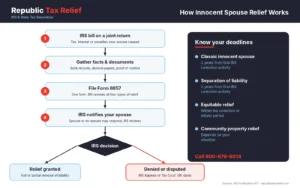
How to Request Innocent Spouse Relief With Form 8857
You request relief by filing IRS Form 8857, Request for Innocent Spouse Relief. One form covers the different types of relief, and the IRS decides which one fits.
Form 8857 Innocent Spouse Relief Tips
- File early. For classic and separation of liability relief, you must file no later than two years after the date the IRS first attempted to collect from you, such as a levy or a refund offset. IRS Publication 971 explains these timing rules.
- Tell the full story. The written explanation carries most of the weight. Describe who handled the money, what you saw, and what you were told.
- Attach proof. Separate bank statements, divorce papers, protective orders, emails, or texts showing your spouse hid information all help.
- Expect your spouse to be contacted. By law, the IRS notifies your spouse or ex-spouse and lets them respond. You can’t file in secret, but you can ask the IRS to protect your address if safety is a concern.
- Know your appeal rights. If the IRS denies your claim, you can go to IRS Appeals. You can also petition the U.S. Tax Court within 90 days of the final determination letter.
Practical takeaway: If you’ve received a levy notice or had a refund taken, write down that date today. Your two-year window may already be running.
Mistakes That Sink a Relief Case
Many denials come from avoidable errors, not weak facts. Watch out for these:
- Waiting too long. Missing the two-year deadline closes the door on two of the four types for good.
- Leaving out abuse or control. Some people skip painful details. Those facts can be the reason relief is granted.
- Assuming a divorce decree ends it. A court order saying your ex pays the taxes doesn’t bind the IRS. You still need to request relief.
- Ignoring your own filings. Unfiled returns for later years can hurt your case. If that’s an issue, see our guide to catching up on unfiled tax returns.
- Letting collections run unchecked. Liens, levies, and garnishments can continue while you wait. A professional can help you address IRS collection actions at the same time.
When to Bring In a Tax Attorney
You can file Form 8857 on your own. But these cases are part legal argument, part evidence, and part timing. A tax attorney or experienced tax professional can help you:
- Pull your IRS transcripts to confirm deadlines and the true balance
- Choose which facts to emphasize for each type of relief
- Build a written narrative backed by documents
- Respond if your spouse disputes your claim
- Handle Appeals or a Tax Court petition if needed
Relief may also be partial. If some balance remains, you may still have options like an IRS installment agreement, Currently Not Collectible status, or penalty abatement. Our tax debt relief options guide explains how these fit together.
“Honestly I didn’t know where to start with my IRS issue but these guys walked me through the whole process. Very friendly, honest and easy to talk to. 5 stars from me.”
— Ryder Knox, ★★★★★ Google Review
Since 2005, Republic Tax Relief’s in-house team of tax attorneys, CPAs, and enrolled agents has resolved more than 18,000 cases. Results vary by individual situation, and no firm can guarantee an IRS outcome, but we can make sure your request is complete, on time, and clearly argued.
Innocent Spouse Relief FAQs
Do I have to be divorced to qualify for innocent spouse relief?
No. You can request classic innocent spouse relief or equitable relief while still married. Only separation of liability relief requires that you be divorced, legally separated, widowed, or living apart for 12 months.
How long do I have to file Form 8857?
For classic and separation of liability relief, you generally must file within two years of the IRS’s first collection activity against you. Equitable relief can be requested any time during the collection period for unpaid tax, or within the refund period if you want money back.
Will the IRS tell my spouse I filed?
Yes. The law requires the IRS to notify your spouse or former spouse and give them a chance to respond. If you have safety concerns, explain them on the form so the IRS can take steps to protect your contact information.
What is the difference between innocent spouse and injured spouse relief?
Innocent spouse relief removes your liability for tax your spouse caused on a joint return. Injured spouse relief, filed on Form 8379, recovers your share of a joint refund that was applied to your spouse’s separate past-due debts.
Can I still get relief if I knew my spouse didn’t pay?
Possibly. Knowledge usually blocks classic relief, but you may still qualify for equitable relief if there was abuse, economic hardship, or other facts showing it would be unfair to hold you liable.
What happens if the IRS denies my request?
You can appeal to the IRS Independent Office of Appeals. You can also petition the U.S. Tax Court within 90 days after the IRS mails its final determination letter.
Key Takeaways
- A joint return makes both spouses liable for the full tax, but the IRS offers four ways out when one spouse caused the problem.
- Classic and separation of liability relief cover understated tax and carry a strict two-year deadline.
- Equitable relief covers unpaid tax too and allows more time.
- Form 8857 starts the process, and your written story plus documents decide most outcomes.
- Professional help reduces the risk of missed deadlines, weak evidence, and lost appeal rights.
Your information is safe with us. Every document you share is protected by bank-grade 256-bit encryption and held under strict tax professional confidentiality, so you can focus on getting relief, not worrying about your privacy.
Speak With a Tax Relief Professional
Being stuck with a spouse’s tax debt is stressful, but you don’t have to sort it out alone. Republic Tax Relief helps individuals and families nationwide request innocent spouse relief, stop IRS collections, and move forward with a clean slate.
Call 800-676-6014 or request your free, confidential consultation today. A tax professional will review your situation and explain your options in plain English.