
Reviewed for accuracy by: Mark Ladd, CEO | Last updated: September 2026
Getting a letter from the IRS is enough to make anyone’s stomach drop. Whether you owe a few thousand dollars or a debt that feels impossible to pay off, you have more options than you probably think. Tax resolution services exist specifically to help taxpayers work through back taxes, penalties, and IRS collection actions without losing sleep or their business. If you owe back taxes or are facing a tax lien, finding reliable tax debt help can prevent sudden bank levies.
This guide walks through what tax resolution actually means, the paths available to settle or manage a tax problem, and how to pick the right professional to handle it for you. If you’re searching for real answers instead of scare tactics, you’re in the right place.
What Is Tax Resolution?
You’ve heard the ads: ‘Pennies on the dollar’ or ‘Settle for next to nothing’. And let’s just say for now that this “might” be true, but there are a lot of traps! Tax resolution is the process of working with the IRS or a state tax agency to settle, reduce, or restructure a tax debt. It covers everything from setting up a payment plan to negotiating a settlement for less than what you owe. This isn’t for everyone!
Most people never think about this process until they’re already in trouble. An unfiled return catches up with them, a business falls behind on payroll tax deposits, or an old debt suddenly triggers a wage garnishment. At that point, tax resolution services step in to figure out which programs a taxpayer actually qualifies for and manage the back-and-forth with the government.
This isn’t a DIY project for most people. The IRS has strict rules about who qualifies for which program, and a single mistake on a form can get an application rejected or delayed for months. Also who you get to help you matters, ALOT! There are some that just do the bare minimum and there are those firms that turn over every stone to see the best option for you. It may take going through a few IRS Settlement Programs before the IRS settles your debt and you benefit greatly. Think of this like having a terrible disease that you have not been diagnosed perfectly yet. What treatment should you do? Not all treatments are a good match. A good doctor will be careful not to throw the kitchen sink at the problem and waste your time, energy, health and money. The same is true of tax resolution tactics. A good resolution team will look to diagnose the issue well before trying to resolve it. Then once they try to resolve it, they need to adjust if needed to the IRS demands. Remember, its not up to the tax resolution firm to decide if you qualify or get approved. They may say you qualify, but do you? In the end, its really up to the IRS approving your petition, the quality of the petition and the planning of the tax relief team you hire that makes it successful or not.
Common Signs You Have a Tax Problem
Not every tax issue requires professional help, but certain warning signs mean it’s time to get someone in your corner:
• You’ve received a CP14, CP504, or Final Notice of Intent to Levy from the IRS
• A state tax agency has sent a collection notice or lien filing
• Your wages, bank account, or business receivables have been levied
• You have unfiled tax returns going back multiple years
• You’re a business owner behind on payroll tax deposits
• You’ve been contacted about an audit
• Your tax debt has grown due to accumulating penalties and interest
If any of these sound familiar, waiting rarely helps. The IRS has strong collection powers, and the sooner a tax professional gets involved, the more options are usually on the table.
Types of Tax Relief and Resolution Options for Federal Tax Debt
There’s no single “fix” for a tax problem. The right solution depends on how much someone owes, why they owe it, and what they can realistically afford. Here are the main resolution paths a tax professional will typically evaluate.
Installment Agreements
An installment agreement lets a taxpayer pay off their balance over time instead of all at once. The IRS offers several versions:
• Streamlined agreements for smaller balances, which usually require less paperwork
• Non-streamlined agreements for larger debts, which require a full financial disclosure
• Partial payment installment agreements, where the monthly payment doesn’t fully pay off the debt before the collection period ends
An installment agreement doesn’t reduce the amount owed (interest and some penalties keep accruing), but it stops active collection efforts like levies as long as payments are made on time.
Offer in Compromise (OIC)
An Offer in Compromise, or sometimes commonly known as the “Fresh Start Program”, allows an eligible taxpayer to settle tax debt for less than the full amount owed. This is the granddaddy of them all, the IRS silver bullet, the IRS debt killer. The IRS calculates something called “reasonable collection potential,” what it thinks it could realistically collect from a taxpayer’s assets and future income, and compares that to the offer amount. This is a powerful strategy to settle your tax debt for less than you owe if you face significant tax liabilities.
This option can genuinely help taxpayers who owe back taxes they’ll never be able to pay in full, but it’s also one of the most misrepresented services in the industry. Not everyone qualifies, and offers get rejected regularly when the numbers don’t add up or the paperwork is incomplete. More important than that, some firms will try to sell this as a one size fits all. It’s not. An Offer in Compromise is an amazing program but you need a skilled tax resolution professional to do it right and a team to back him up. Think of going to court and having a killer attorney VS an inexperienced public defender. Who do you want having your back against the IRS. You only have once chance at doing this right. If you try to do it yourself and fail, your OIC and everything you submitted in error becomes part of your casefile. If you try to resubmit once you find out your errors, you face an uphill, almost losing battle. DO IT RIGHT THE FIRST TIME!
Currently Not Collectible (CNC) Status
If a taxpayer truly can’t afford to pay anything toward their tax debt without covering basic living expenses, the IRS can place their account in Currently Not Collectible status. This pauses collection activity, though the debt doesn’t disappear and interest continues to build. But there are catches here too. If you plan to buy a home, your income is going to go up substantially or you plan to come into a great deal of money from a lawsuit, inheritance or you find a bag of diamonds in your backyard, the IRS will approve this petition now but will remove you from it in the future. The IRS has 10 years to collect on this debt. Can you wait them out?
Penalty Relief and Penalty Abatement
Penalties can make up a large chunk of a tax bill. Penalty relief, sometimes called penalty abatement, asks the IRS to remove or reduce penalties, usually because of reasonable cause (illness, natural disaster, bad professional advice) or because it’s the taxpayer’s first time facing that particular penalty.
A tax professional who knows how to write and support a penalty abatement request can sometimes shave a significant amount off a tax bill without touching the underlying tax owed. We love this and lots of people can get this if the petition is crafted correctly.
Innocent Spouse Relief
Your spouse did you dirty and now you are left holding the bag. When a joint tax return results in a debt caused by one spouse’s actions, such as unreported income or fraudulent deductions, the other spouse may qualify for innocent spouse relief, which separates their liability from the debt. You can’t just say “its not my fault, it was theirs.” Your Innocent Spouse petition needs to be spot on and have a very good argument and requires almost always a professional to structure the argument the right way. You need a good plan to buy successful here.
Audit Representation
If a return is being audited, a tax professional can represent the taxpayer directly, respond to IRS requests, and negotiate the outcome. Having representation often changes the tone and outcome of an audit significantly. All too often the IRS will bully you with audits. You get an IRS FORM CP2000, Form 4564 or Form 4549 and you want to just submit what you have. STOP! Be careful what you send. Sending too much or too little or the wrong information may not help your case and hurt it. It may also drag other parts of your tax filing that the IRS is not prepared to audit and make it vulnerable to adjustments. You need to do this right the first time.
Wage Garnishment and Tax Lien Release Strategies
If the IRS has already started garnishing wages or levying a bank account, a tax professional can sometimes negotiate a release, especially if it’s causing serious financial hardship or if an installment agreement or Offer in Compromise is already in progress.
Table: Common IRS Resolution Options at a Glance
|
Resolution Option |
Best For |
What It Does |
|
Installment Agreement |
Taxpayers who can pay over time |
Spreads the debt into monthly payments |
|
Offer in Compromise |
Taxpayers who can’t pay the full balance, ever |
Settles debt for less than owed |
|
Currently Not Collectible |
Taxpayers in financial hardship |
Pauses IRS collection activity |
|
Penalty Abatement |
Taxpayers with reasonable cause or a clean history |
Removes or reduces penalties |
|
Innocent Spouse Relief |
A spouse not responsible for the debt |
Separates liability on a joint return |
|
Audit Representation |
Taxpayers under IRS audit |
Professional handles communication and negotiation |
How Tax Resolution Specialists Help You Deal With the IRS
Not every “tax relief company” employs people who are legally allowed to represent you before the IRS. This matters more than most people realize, so it’s worth understanding the differences.
Enrolled Agents
An enrolled agent is a tax professional licensed directly by the federal government, specifically to represent taxpayers before the IRS. Enrolled agents either pass a rigorous IRS exam covering individual and business tax law or have direct work experience at the IRS itself. They can represent taxpayers in any state, for any type of tax issue, without limitation. Licensed tax professionals can negotiate directly with an IRS office or speak to the IRS on your behalf.
CPAs
Certified Public Accountants are licensed at the state level and can represent taxpayers before the IRS as well. Many CPAs focus primarily on accounting, bookkeeping, and tax preparation rather than tax debt negotiation, but some specialize in resolution work.
Tax Attorneys
Tax attorneys are especially useful when a case involves potential criminal exposure, complex litigation, or state court involvement. For a straightforward back-tax situation, a tax attorney isn’t always necessary, though some resolution firms keep one on staff for complicated cases.
Whichever type of professional you work with, make sure they can prove they’re authorized to represent taxpayers before the IRS. A Power of Attorney (Form 2848) is the document that gives them that authority.
How to Choose the Best Tax Relief Companies
The tax relief industry has a reputation problem, mostly earned by a handful of companies that made big promises and delivered very little. A few things separate a trustworthy tax resolution company from one to avoid:
• They evaluate your situation before quoting a price. Legitimate firms review your IRS transcripts and financial situation before telling you what programs you might qualify for.
• They’re upfront that not everyone qualifies for an Offer in Compromise. Anyone who guarantees a settlement for “pennies on the dollar” before reviewing your case is not being straight with you.
• They employ enrolled agents, CPAs, or tax attorneys, not just sales staff.
• They explain the process clearly, including realistic timelines, since IRS cases often take months to resolve.
• They have verifiable reviews and a track record, not just glowing testimonials on their own website.
If a company pressures you to sign paperwork or pay large upfront fees on your first phone call, that’s a signal to slow down and ask more questions.
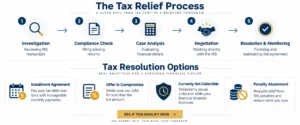
The Step-by-Step Tax Relief Process for Resolving IRS Debt
Most legitimate tax resolution services follow a similar general process, even if the details vary firm to firm:
1. Investigation. Your professional pulls your IRS transcripts and reviews exactly what’s owed, for which years, and why.
2. Compliance check. The IRS generally won’t negotiate a resolution until all required tax returns have been filed. Missing returns usually need to be completed first.
3. Case analysis. Based on your income, expenses, assets, and the type of debt, your tax professional identifies which resolution options you actually qualify for.
4. Negotiation. Your representative communicates directly with the IRS or state tax agency, submitting the paperwork for whichever program fits your situation.
5. Resolution and monitoring. Once an agreement is in place, a good firm helps make sure you stay compliant so the resolution doesn’t fall apart.
What Tax Resolution Cannot Do
It’s worth being honest about the limits here, because plenty of companies aren’t. No professional, no matter how experienced, can guarantee a specific settlement amount before reviewing your financial details. The IRS makes that determination based on formulas tied to your actual income and assets, not on how good a negotiator someone is.
Tax resolution also cannot make a legitimate debt disappear without qualifying for a real program, and it cannot stop the IRS from filing a lien or levy if a taxpayer doesn’t respond or cooperate along the way.
The Taxpayer Advocate Service: A Free Resource
Before hiring anyone, it’s worth knowing that the Taxpayer Advocate Service exists. The Taxpayer Advocate Service is an independent organization within the Internal Revenue Service whose job is to help ensure every taxpayer is treated fairly and understands their rights. It offers free help to guide taxpayers through the process of resolving problems they haven’t been able to solve on their own, especially when a tax issue is causing financial hardship or the IRS hasn’t responded to repeated attempts at contact.
The Taxpayer Advocate Service can be a good first stop if you’re stuck in IRS red tape, though it’s not a substitute for representation in a negotiation like an Offer in Compromise. For that, most people still benefit from hiring a tax professional who does this work daily.
IRS Programs Taxpayers Should Know About
The IRS’s Fresh Start initiative expanded access to several relief options, including streamlined installment agreements, an Offer in Compromise program with updated qualification formulas, and penalty abatement for first-time offenders and reasonable-cause situations. Being current on filing all required returns is generally a prerequisite before the IRS will consider any of these options.
In a recent year, just over 4 million Americans had an IRS payment plan in place, and nearly 215,000 taxpayers had an Offer in Compromise accepted. That’s a reminder that these programs are real and regularly used, even though not every application succeeds.
Business Tax Problems Are Different
Business owners face a version of tax debt that individuals usually don’t: payroll tax. When a business falls behind on payroll tax deposits, the IRS treats it far more seriously than income tax debt, because the withheld amounts belong to employees, not the business.
The IRS can pursue the Trust Fund Recovery Penalty against the individuals responsible for payroll decisions, even personally and outside the business itself. This makes fast professional intervention especially important for business owners who fall behind, since delays can turn a business problem into a personal one. Business owners facing payroll tax issues often need expert tax relief before penalties accumulate.
A Real Client Story
Sometimes the clearest picture of what tax resolution looks like comes from someone who’s actually been through it.
|
Client Review |
|
“I filed my 2025 taxes just to find out I owed quite a bit – I spoke with Ryan who was super kind and helpful. He guided me through the process which was simple and easy. Turns out it was an old W-2 that I missed back in 2023. After finding out, Rebecca was able to help me get everything up to date. Definitely saved me a lot of time, stress, and money!” |
|
— Cristina Spruell |
This is a common story: a missed W-2 or unreported income from a prior year resurfaces and turns into an unexpected tax bill. In cases like this, the fix is often more straightforward than people fear once someone experienced is looking at the full picture.
Frequently Asked Questions
Can tax debt actually be settled for less than what’s owed?
Yes, through an Offer in Compromise, but only if the numbers support it. The IRS looks at what it could realistically collect from your assets and income, not just what you’d prefer to pay.
What happens if I ignore an IRS notice?
Ignoring notices generally leads to escalating collection action: liens, levies, or wage garnishment. Responding early, even just to buy time, keeps more options open.
Is tax resolution only for people who owe a huge amount?
No. Tax resolution covers everything from a few thousand dollars in back taxes to six- and seven-figure business tax liabilities. The right resolution just depends on the numbers.
How long does tax resolution usually take?
It varies widely. A simple installment agreement can be set up in weeks. An Offer in Compromise or a complicated multi-year case can take several months to over a year.
Do state tax debts work the same way?
Not exactly. Each state runs its own collection process and relief programs, so a resolution strategy for state tax debt often looks different from an IRS strategy, even when the same tax professional handles both.
If you’re dealing with back taxes, an IRS notice, or a growing tax problem, the most important step is simply not waiting. A qualified tax professional can review your situation, tell you honestly which programs you might qualify for, and start working toward a resolution before it gets worse.
Call us at 800-676-6014 for a free consultation.